
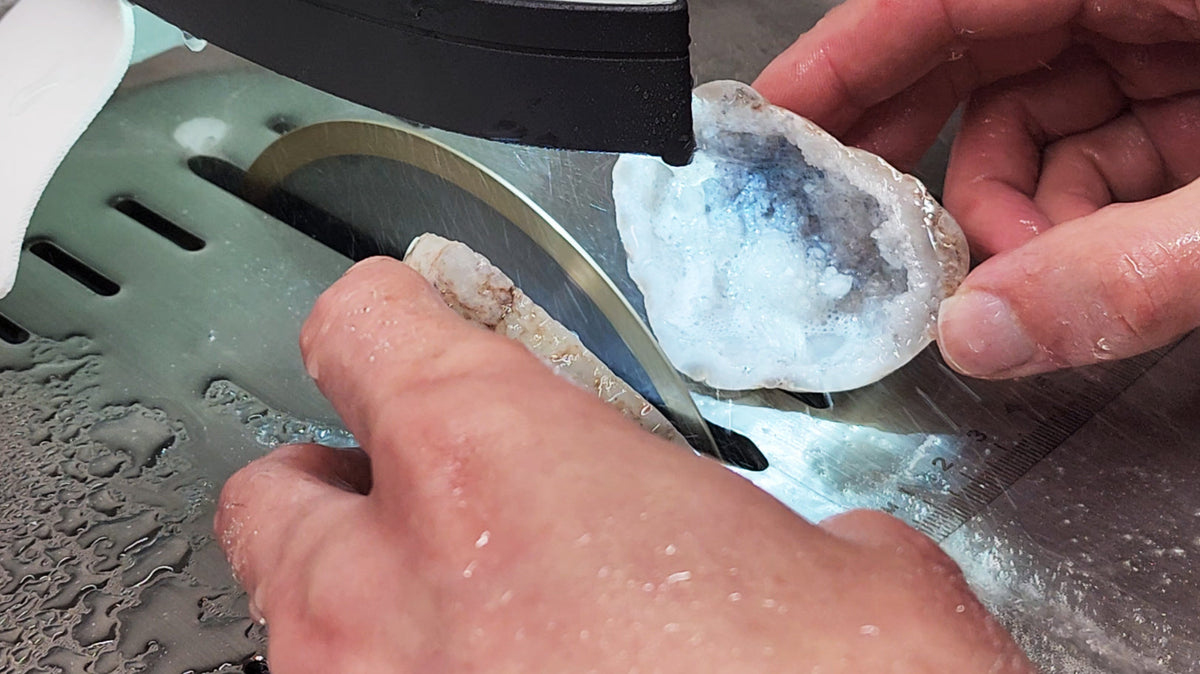
Quick Answer: Can a Wet Tile Saw Cut Agate?
Yes. Some wet tile saws can cut agate, jasper, quartz and other rocks with a suitable diamond blade, sufficient water cooling and secure workholding. A dedicated lapidary saw is often a better fit for repeated trimming, irregular stones and projects that demand controlled, consistent cuts. The key difference is not simply whether a blade can cut rock; it is how well the complete setup supports the job.
Wet Tile Saw vs. Lapidary Saw: Side-by-Side Comparison
| Feature | Wet Tile Saw | Dedicated Lapidary Saw | ToAuto Smart Lapidary Saw |
|---|---|---|---|
| Primary use | Tile and construction materials | Rocks, minerals, gemstones | Lapidary and gemstone projects |
| Speed control | Varies; often fixed-speed | Fixed or variable by model | Adjustable to 5,000 RPM; 50 RPM fine adjustment |
| Blade | Tile-rated diamond blade | Lapidary diamond blade | Compatible approved diamond blade |
| Stone holding | Tile guides or sliding tray | Stone-specific vises or fixtures may be available | Adjustable clamp configuration; confirm included accessories |
| Cooling | Typically water-fed | Manufacturer-specified coolant | Gravity-fed water system |
| Best fit | Tile work and some occasional rock cutting | Repeated rock cutting | Controlled cutting of compatible rocks and minerals |
1. RPM: Is Faster Always Better?
No. The appropriate blade speed depends on blade diameter, blade design, stone structure, coolant delivery and the manufacturer's operating limits. Some tile saws are fixed-speed, and lapidary saws can be either fixed- or variable-speed. There is no universal RPM that works for every agate or jasper. For more practical guidance, explore our lapidary saw speed guides. Too much feed pressure, an unsuitable blade, poor cooling or an unstable workpiece can affect cut quality regardless of RPM.
The ToAuto Smart Lapidary Saw uses a 400W brushless DC motor, an LCD controller and adjustable machine speed up to 5,000 RPM, including 50 RPM fine adjustments. That flexibility helps users tune an approved cutting setup for different materials. The maximum machine speed is not a recommended operating speed for every blade or stone. Always check the blade's rated maximum RPM.
2. Blade Kerf: How Much Material Will You Lose?
Kerf is the width of material removed by a cut. It matters when trimming small specimens or valuable rough. Both tile and lapidary blades come in different thicknesses, so it is inaccurate to assume every tile blade is thick or every lapidary blade is ultra-thin. A thinner blade can reduce material loss, but it must also be appropriate for the machine, cutting load and material.
Before choosing a diamond blade, verify its diameter, arbor fit, thickness, rim design, rated RPM, intended material and coolant requirements. For a ToAuto 6-inch or 8-inch saw, use the specifications approved for that exact model.
3. Holding an Irregular Rock Securely
Construction tiles are typically flat. Agate nodules, geodes and rough gemstones may be rounded, uneven or difficult to position. A tile guide or sliding tray may not securely support a small irregular stone. If a rock shifts, twists or binds during cutting, the workpiece and operator can be put at risk.
Use a clamp, vise or other workholding method approved for the specific saw and cutting operation. Proper workholding helps maintain orientation and keep hands farther from the blade, but it does not eliminate cutting hazards. ToAuto offers an adjustable safety cutting clamp concept; confirm the exact clamp or guide-rail slider configuration and whether it is included or sold separately before ordering.
4. Water Cooling and Cleanup
Water helps cool the blade and cutting zone, carry away debris and reduce airborne dust. Many tile saws use recirculating pumps; lapidary saws may use water-fed or other manufacturer-approved cooling arrangements. The ToAuto Smart Lapidary Saw uses a gravity-fed coolant reservoir and a drainage worktable. Reliable delivery, containment and regular cleaning matter more than the presence of a water tray alone. Wet cutting reduces dust exposure but does not eliminate it.
5. What Actually Produces a Clean Cut?
Cut quality is the result of blade condition, alignment, secure stone positioning, feed pressure, coolant delivery, material fractures and suitable speed selection. A saw's maximum RPM or price alone cannot guarantee smooth results. Agate banding, jasper structure, brittle obsidian and fractured quartz may each require different handling and care.
When Does a Wet Tile Saw Make Sense?
A compatible wet tile saw may be sufficient for occasional rock-cutting experiments, especially if you already own one, the stone can be securely supported, and the blade and cooling system are appropriate. Check the manufacturer's instructions before cutting anything other than the saw's stated materials.
When Is a Dedicated Lapidary Saw Worth It?
Consider a dedicated lapidary saw if you cut agate and jasper regularly, prepare rough for cabochons, need repeated controlled slices, work with small or irregular pieces, or want a setup designed around a lapidary workflow. Choose based on the size of your typical stones, cutting depth, blade compatibility, workholding and available workspace.
ToAuto Smart Lapidary Saw: More Control for Your Projects
ToAuto's 6-inch and 8-inch Smart Lapidary Saw platforms feature a 400W brushless DC motor, adjustable machine speed up to 5,000 RPM, 50 RPM fine adjustment, a 4-inch LCD controller, a 4 mm 304 stainless steel worktable and gravity-fed water cooling. The 6-inch model is suited to smaller trimming projects; the 8-inch option may better suit users who need additional cutting capacity. Confirm the exact SKU, blade, workholding accessories and cutting-depth specifications before purchase.
Explore ToAuto Smart Lapidary Saws and choose the configuration that fits your stone sizes, cutting projects and workshop.
Frequently Asked Questions
Can you cut agates with a wet tile saw?
Yes, some wet tile saws can cut agate when equipped with a suitable diamond blade, adequate water cooling and secure workholding. Check the saw and blade manufacturers' guidance.
Is a tile saw the same as a lapidary saw?
No. Tile saws are primarily designed for construction materials, while lapidary saws are designed for rocks, minerals and gemstones. Individual machines differ in blades, fixtures, speed options and cutting capacity.
What RPM should I use for cutting agate?
There is no single RPM suitable for every setup. Follow the machine and blade manufacturers' operating limits, taking into account blade diameter, material, coolant and feed pressure.
Do I need a special blade for gemstones?
Use a diamond blade rated for the stone and compatible with the machine's diameter, arbor, maximum RPM and coolant requirements.
Can I hold a small rock by hand?
Use an approved workholding arrangement appropriate to the stone and machine. Avoid improvised fixtures and keep hands away from the blade.
Is a thinner blade always better?
No. Thin blades may reduce kerf loss but can be more susceptible to deflection or damage. Select the blade for the cutting task and machine.
Should I choose a 6-inch or 8-inch lapidary saw?
A 6-inch model may be sufficient for smaller trimming projects; an 8-inch model generally offers more cutting capacity. Verify the exact cutting-depth and fixture specifications.
Can a lapidary saw cut quartz or petrified wood?
A compatible lapidary saw with an appropriate diamond blade can cut many quartz-rich materials, including quartz and petrified wood. Follow the machine and blade instructions.
Explore More Lapidary Guides
Continue learning about diamond blade selection, lapidary saw RPM, and ToAuto cutting machines.
Explore Related ToAuto Resources
Compare the ToAuto Smart Lapidary Saw, review the 6-inch and 8-inch cutting saw specifications, or find more answers in the lapidary saw FAQ.
Final Verdict
A wet tile saw can be a reasonable entry point for occasional rock cutting. A dedicated lapidary saw is often a more suitable investment for repeatable gemstone trimming and a purpose-built workflow. Compare blade compatibility, speed control, stone stability, cooling, cutting capacity and long-term usability—not just motor power or price.
Safety: Follow the saw and blade manufacturers' instructions, use appropriate eye protection and dust controls, keep guards installed, secure the workpiece and keep hands away from the blade. Never operate a blade beyond its rated RPM.

Leave a comment
All comments are moderated before being published.
This site is protected by hCaptcha and the hCaptcha Privacy Policy and Terms of Service apply.